On This Day in Indianapolis History by Bakken Dawn E
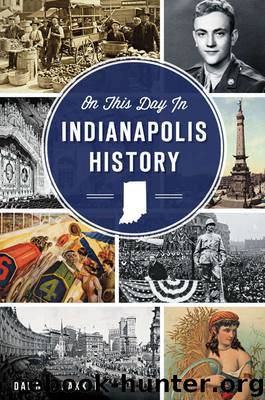
Author:Bakken, Dawn E. [Bakken, Dawn E.]
Language: eng
Format: epub
Publisher: Arcadia Publishing Inc.
Published: 2016-01-18T05:00:00+00:00
Courtesy of Historic American Buildings Survey, Library of Congress .
July 4, 1822
Settlers were still putting up log cabins when the citizens of Indianapolis, few in number, gathered to celebrate their first Fourth of July. A committee of residents had established a formal program for the day, which began with singing, prayers and a sermon. The Declaration of Independence was read to those assembled and then Washington’s Inaugural Address and his Farewell Address. More singing and prayers concluded the program. The men of the town then sat down to enjoy a barbecue set up in the middle of Washington Street—a deer that had been shot near one end of that same street—after which they repaired to Jacob Crumbaugh’s tavern for the evening. Sarah Fletcher’s diary entry for the day records the events: “This day there apered to be a great stir & livelaness among the people. The men had a barbacu & dined under the green sugar trees at the West end of Washington St. The Evening of the same day Mr. Crumbaugh had a large party held at his dwelling.”
July 5, 1911
“Taft Honor Is Genuine. Marked Enthusiasm and Hoosier Cordiality Characterize Reception of President,” read the headline of the Indianapolis Star . Taft, at the invitation of former vice president and Indianapolis resident Charles Fairbanks, toured the city for an entire day, making ten speeches. He was fêted at the Columbia Club and cheered by “the people of Indianapolis [who] turned out en masse” despite a record heat wave and a high temperature that particular afternoon of 103 degrees. In his impromptu speech after lunch, Taft praised both Indiana and its capital. And as he rode down Meridian Street to a reviewing stand on the Circle, Taft appeared to be impressed by the “inspiring sight” of people “banked in a solid mass of humanity” despite the day’s heat, which “danced and pirouetted and turned somersaults on the brick walls and asphalt pavements.”
July 6, 1924
As a young woman, Mary Rigg trained first as a teacher, taking her bachelor’s degree at Indiana University, and then as a professional social worker, studying in New York City. In 1919, Rigg moved to Indianapolis, where she became the director of the American Settlement House in 1924. In July, she was interviewed by a reporter from the Indianapolis Star . Rigg summed up her primary goal as “Americanization…the great, the leading thought in everything we do.” In an area filled with immigrants (Rigg mentioned families from Romania, Serbia, Bulgaria, Greece, Poland, Turkey and Italy) all “employed near by in the packing houses, abbatoir, railroad yards and factories,” Rigg and her employees offered a medical clinic and dispensary; the services of a visiting nurse and doctor; classes for mothers on childcare, cooking, family health and home sanitation; and classes in English and citizenship. For children, the settlement offered a playground, a day nursery, Boy Scouts and cooking and sewing clubs for girls. In every instance, introducing the immigrants to modern American ways was an integral part of the service offered.
Download
This site does not store any files on its server. We only index and link to content provided by other sites. Please contact the content providers to delete copyright contents if any and email us, we'll remove relevant links or contents immediately.
The Great Music City by Andrea Baker(32610)
Aircraft Design of WWII: A Sketchbook by Lockheed Aircraft Corporation(32333)
Call Me by Your Name by André Aciman(20604)
The Secret History by Donna Tartt(19305)
The Art of Boudoir Photography: How to Create Stunning Photographs of Women by Christa Meola(18688)
Shoot Sexy by Ryan Armbrust(17788)
Plagued by Fire by Paul Hendrickson(17464)
Portrait Mastery in Black & White: Learn the Signature Style of a Legendary Photographer by Tim Kelly(17053)
Adobe Camera Raw For Digital Photographers Only by Rob Sheppard(17031)
Photographically Speaking: A Deeper Look at Creating Stronger Images (Eva Spring's Library) by David duChemin(16735)
Ready Player One by Cline Ernest(14777)
Pimp by Iceberg Slim(14668)
Bombshells: Glamour Girls of a Lifetime by Sullivan Steve(14138)
The Goal (Off-Campus #4) by Elle Kennedy(13781)
Art Nude Photography Explained: How to Photograph and Understand Great Art Nude Images by Simon Walden(13093)
Kathy Andrews Collection by Kathy Andrews(11977)
The Priory of the Orange Tree by Samantha Shannon(9207)
The remains of the day by Kazuo Ishiguro(9087)
Thirteen Reasons Why by Jay Asher(8998)
